



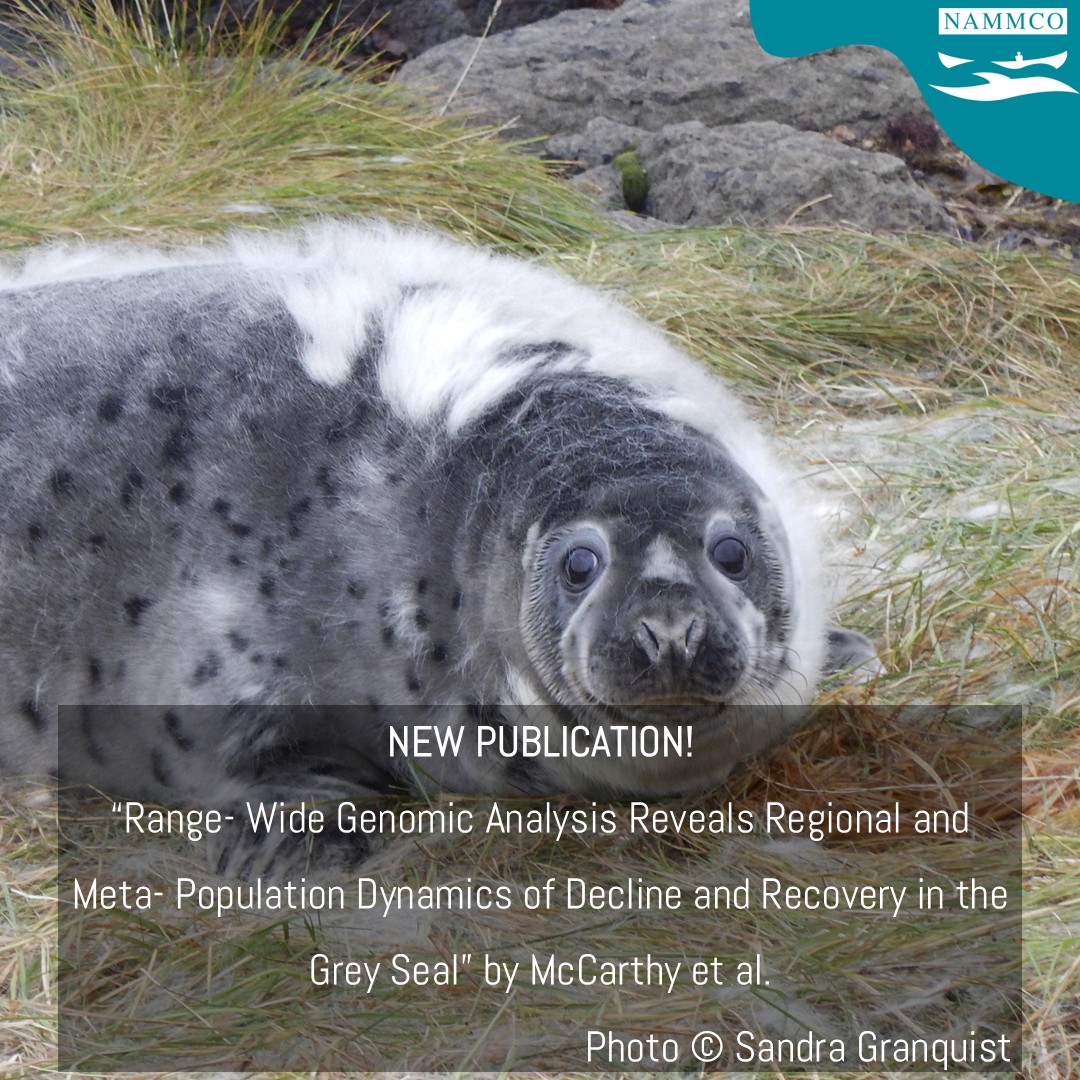
8 August 2026: A new genomic study of grey seals in the North Atlantic
A study by McCarthy and colleagues, titled “Range- Wide Genomic Analysis Reveals Regional and Meta- Population Dynamics of Decline and Recovery in the Grey Seal”, was published in the Science journal in June 2025.
Human pressure has historically caused drastic population declines in various species. Recent conservation efforts have helped many species to recover, with some experiencing a rapid increase in numbers. But significant population shrinking or growth can change a species’ genomic composition and population structure.
This study investigated the impacts of population decline and recovery by performing a range-wide genomic analysis of the grey seal. In other words, it analysed the species’ entire genome (all the DNA in their cells) using tissue samples collected from across the grey seal’s geographic distribution (specifically, 118 samples collected from 17 different locations). The grey seal was chosen as an ideal species for this study because it suffered large population declines in the past, due to hunting and environmental changes, but has recently seen a rapid population growth.
The results confirmed the existence of three main populations of grey seals, respectively in the Northwest Atlantic, Northeast Atlantic, and the Baltic Sea. The Northwest Atlantic population had significantly lower genetic diversity than the other two populations, that is, little variety in the genes of different animals within the population. This indicates that what was originally a large population likely underwent a dramatic decline at some point: for the Northwest Atlantic population, this probably happened during the industrial seal hunting era of the 19th and 20th centuries.
Additionally, the study found considerable genomic differences between the Northeast Atlantic and Baltic Sea populations, despite being geographically close. This suggests that certain barriers, like the semi-enclosed nature and different environmental conditions of the Baltic Sea, have historically prevented both populations from mixing with each other.
While acknowledging the existence of logistical and financial limitations, the authors point to the importance of performing range-wide genomic studies to better understand a species’ history and the effects of rapid changes in population numbers.
Read the full paper by McCarthy et al HERE.
Photo credit: Sandra Granquist