



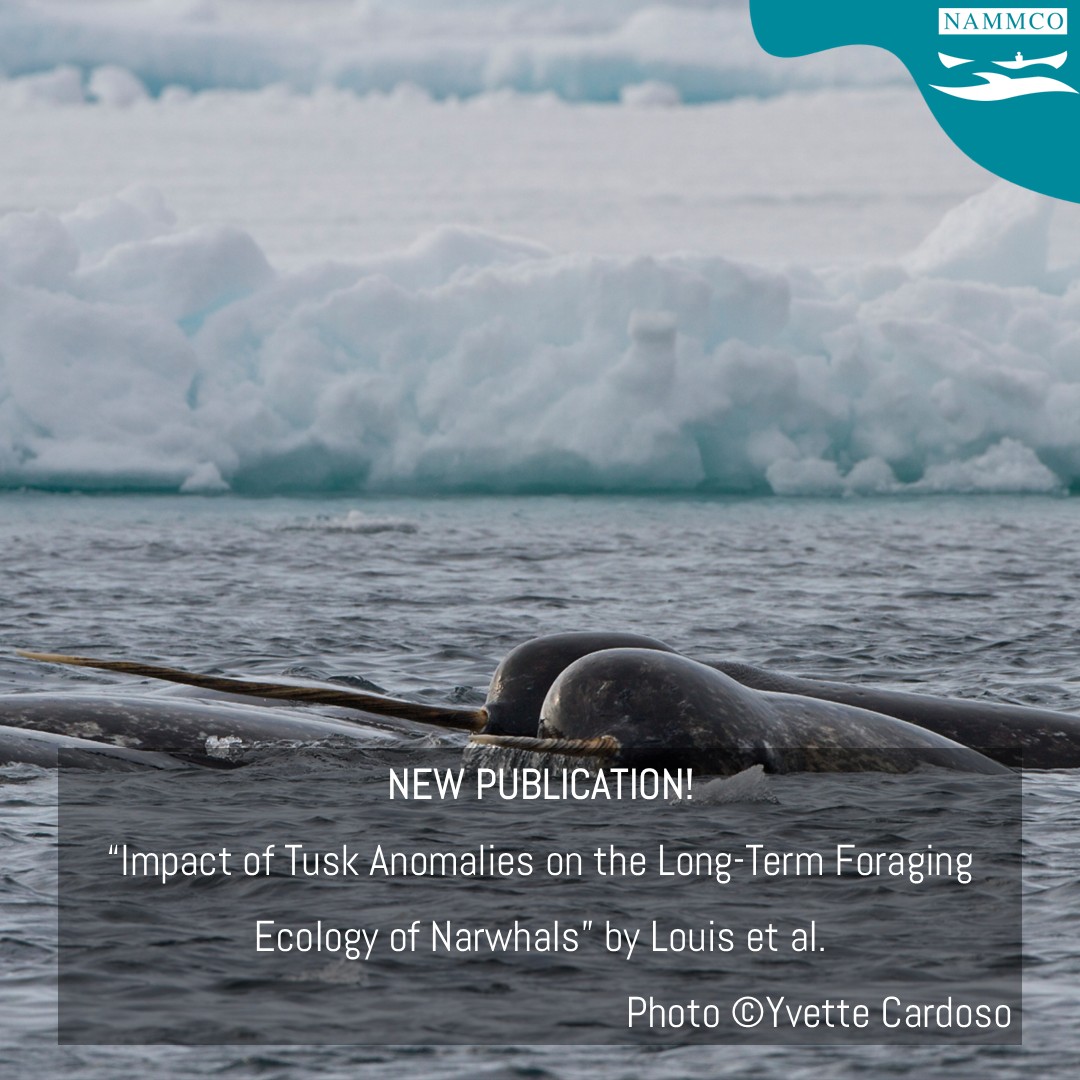
18 February 2026: A new study on the Impact of tusk anomalies on the long-term foraging ecology of narwhals
A study by Louis and colleagues, titled “Impact of tusk anomalies on the long-term foraging ecology of narwhals”, was published in the journal Ecology and Evolution in November 2025.
Narwhals are well-known for having a long, spiralled tusk (formed from their left canine tooth), a characteristic generally unique to male individuals. However, in some cases, females may also develop a tusk, while some males may develop two. These cases constitute tooth anomalies that could impact the hunting behaviour of the affected individuals. Such cases have been observed in other mammal species, and in a hybrid individual born from a narwhal and a beluga (Narluga).
Louis and colleagues used bone collagen stable isotope analyses to compare 15 narwhal specimens with tusk anomalies with normal specimens. Stable isotopes reflect the type of prey an animal has been consuming; measuring these values in bone collagen reveals long-term feeding habits. Thus, comparing abnormal narwhal specimens with their normal male and female counterparts can indicate whether their tooth anomalies had long-term impacts on their hunting behaviour.
Among the sampled narwhals, the majority of the two and one-tusked anomalous individuals showed normal isotopic values; therefore, the presence of an extra tusk does not appear to systematically impact narwhal hunting behaviour. However, two samples with highly unusual tusk anomalies (such as beluga-like teeth) showed abnormal isotopic values, indicating that their hunting behaviour had been impacted.
Louis and colleagues concluded that the most common tusk anomalies in narwhals appear to have limited ecological consequences, while rarer forms of tusk anomalies are likely associated with altered feeding habits.
You can read the full article by Louis et al., HERE!
Photo credit: Yvette Cardoso.