



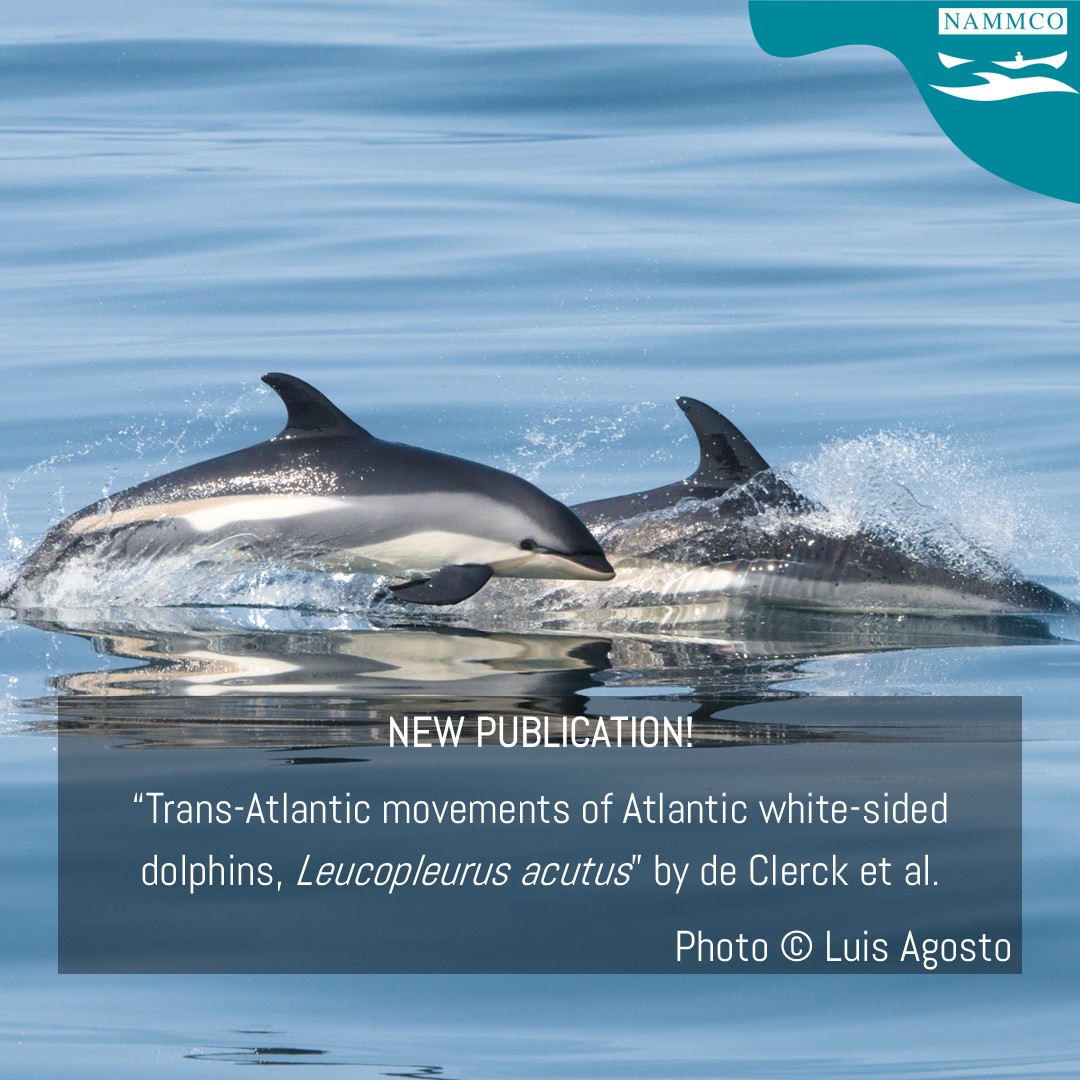
5 January 2026: A new study on the Trans-Atlantic movements of Atlantic white-sided dolphins.
A new study by De Clerck and colleagues, titled “Trans-Atlantic movements of Atlantic white-sided dolphins, Leucopleurus acutus”, was published in the journal Frontiers in Marine Science in December 2025.
Atlantic white-sided dolphins are a wide-ranging and abundant species of the North Atlantic, yet their movements remain poorly understood. The authors tracked the movements of 23 dolphins that they tagged in the Faroe Islands, with the support of traditional drive hunting expertise. They then investigated their movement patterns, habitat use, and diving behaviour.
The results confirm that these dolphins have a strong association with the continental shelf edge, a transition region in the ocean between the continent and the deep ocean floor. The dolphins spend extensive time in the Irminger Sea and the Faroe-Shetland Channel, highlighting the importance of these two regions as likely feeding grounds. The authors observed that these dolphins move in areas of the ocean where conditions make food abundant and available.
This study supports the conservation and management of Atlantic white-sided dolphins by highlighting the value of movement data in understanding how these animals utilise their habitat, their distribution in the North Atlantic, the impact of ocean conditions on them, and the structure of their population. Identifying critical habitats and understanding how dolphin species are connected across the Atlantic is essential for their conservation, considering ongoing environmental changes.
You can read the article by De Clerck et al. here: https://doi.org/10.3389/fmars.2025.1636440
Photo credit: Luis Agosto.