



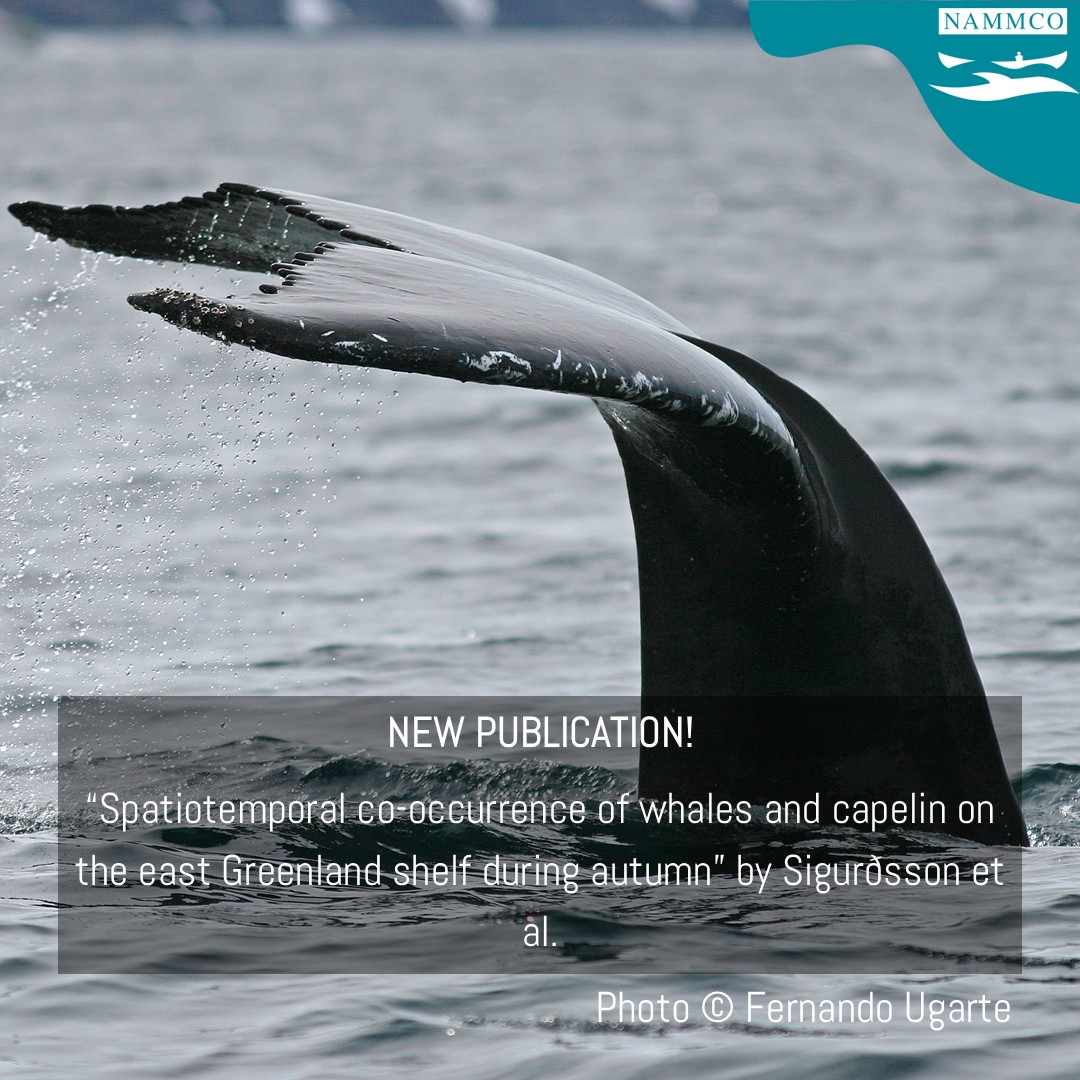
December 17 2025: A new study on the spatiotemporal co-occurrence of whales and capelin on the east Greenland shelf during autumn.
A new study by Sigurðsson and colleagues, titled “Spatiotemporal co-occurrence of whales and capelin on the east Greenland shelf during autumn”, was published in the journal Marine Biology in November 2025.
The waters between Iceland and East Greenland have experienced large-scale ecological changes over the last 30 years. Key fish species for the local ecosystem, such as capelin, have shifted their distribution northwards. Sub-Arctic species like humpback and fin whales have moved into this region from further south and are remaining there for longer periods than before.
In this study, the authors investigated the relationship between whales and capelin. They aimed to study whether whales previously associated with capelin would be found in greater numbers where capelin is present, despite the great changes in the ecosystem. For the study, data were collected in East Greenlandic waters in 2017 and 2018. Whales were counted by dedicated observers on board research and fishing vessels, while capelin abundance was estimated using acoustic methods.
The authors identified a significant relationship between capelin abundance and total whale abundance, with fin, minke, and humpback whales having the strongest positive relationships; that is, the more capelin, the more whales.
These results indicate that whales are likely following capelin during these changing times. Some species, like the humpback and minke whales, might be directly following the capelin to hunt them, while others, like blue and fin whales, might be feeding on the same prey as the capelin, thus indirectly following them.
You can read the full article by Sigurðsson et al., here
Photo credit: Fernando Ugarte.