


27 March 2026: Press release of the 33rd Annual Meeting of the North Atlantic Marine Mammal Commission
North Atlantic cooperation for sustainable and responsible marine mammal management in times of climate change
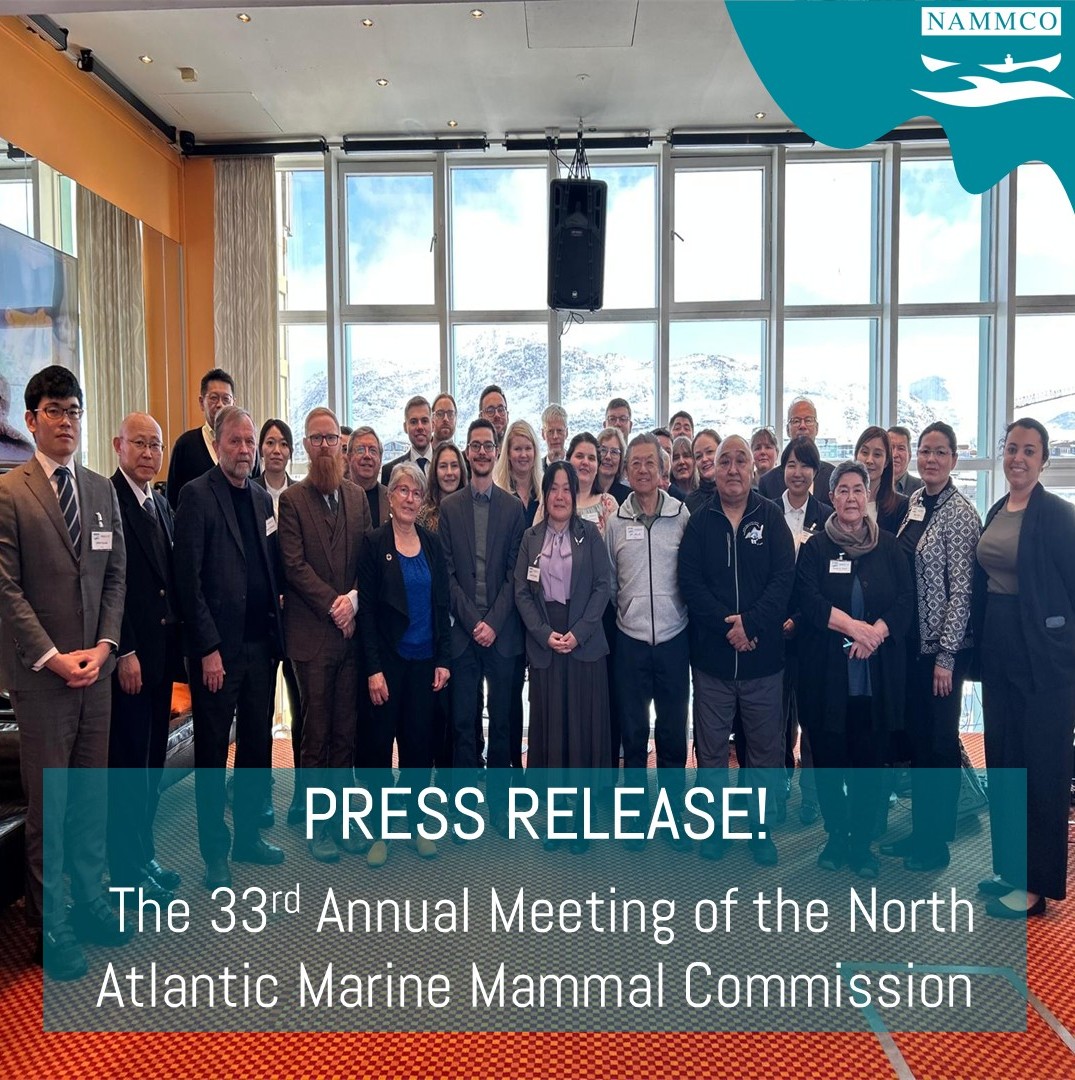
At NAMMCO’s 33rd Annual Council Meeting, held from 24 to 26 March 2026 at Hotel Hans Egede, Nuuk, member countries reaffirmed their commitment to strengthening regional cooperation on the conservation and management of marine mammals in the North Atlantic, as well as their responsible and sustainable use. The Commission further discussed its management processes in the context of ongoing and future climate and environmental changes. The Opening Session featured a discussion on how these changes are already impacting coastal communities both in terms of access to and availability of marine mammal resources in Greenland.
NAMMCO advises a zero-catch limit for narwhal and beluga in East Greenland
Due to the categorisation as small stocks of narwhal and low numbers of beluga in East Greenland, NAMMCO endorsed the recommendation of its Scientific Committee to implement zero catches of these species in the area. Narwhal hunting in particular is of great cultural and socio-economic significance to coastal communities in East Greenland. This measure aims at increasing the numbers of both species, so that they remain available for future generations.
The Council highlighted concerns about the consequences of increasing anthropogenic effects in East Greenland, including pollution, shipping, cruise ship tourism, and military activities, as well as climate change. The combination of these factors poses a significant challenge for marine mammal management and conservation.
Faroese and Greenlandic pilot whale catches are considered sustainable
The Scientific Committee of NAMMCO conducted a full assessment of long-finned pilot whales in the North Atlantic, using the most recent abundance estimates generated by the 2024 North Atlantic Sightings Survey (NASS).
The analysis concludes that the pilot whale population from Norway to West Greenland, estimated at 320,000 individuals, can sustain annual removals of up to 1,570 animals. Annual catches in recent years in the Faroe Islands and Greenland remain well within sustainable catch limits.
Evidence-based management of cetaceans: MINTAG and population monitoring
The Miniature Tag Project (MINTAG), a cooperation between NAMMCO member countries and NAMMCO observer country Japan, aims at developing smaller tags to study the movements of fin, sei, minke, and pilot whales, which are difficult to tag. These tags will help us better understand their migration patterns and population structure. In 2025 the project partners carried out the third year of tag deployments, showing new migration routes for pilot whales and fin whales along the Norwegian coast to the United Kingdom and Ireland.
For more details, visit the MINTAG website here.
NAMMCO’s long-standing commitment to monitoring marine mammal populations is shown through large-scale dedicated surveys, NASS, as well as a continued effort to improve survey methods through expert workshops on alternative survey and modelling methods. Incorporating such methods will allow more frequent monitoring and make it easier to detect changes in abundance and distribution over time.
The agenda, list of participants, and documents for the Council meeting can be found here.