



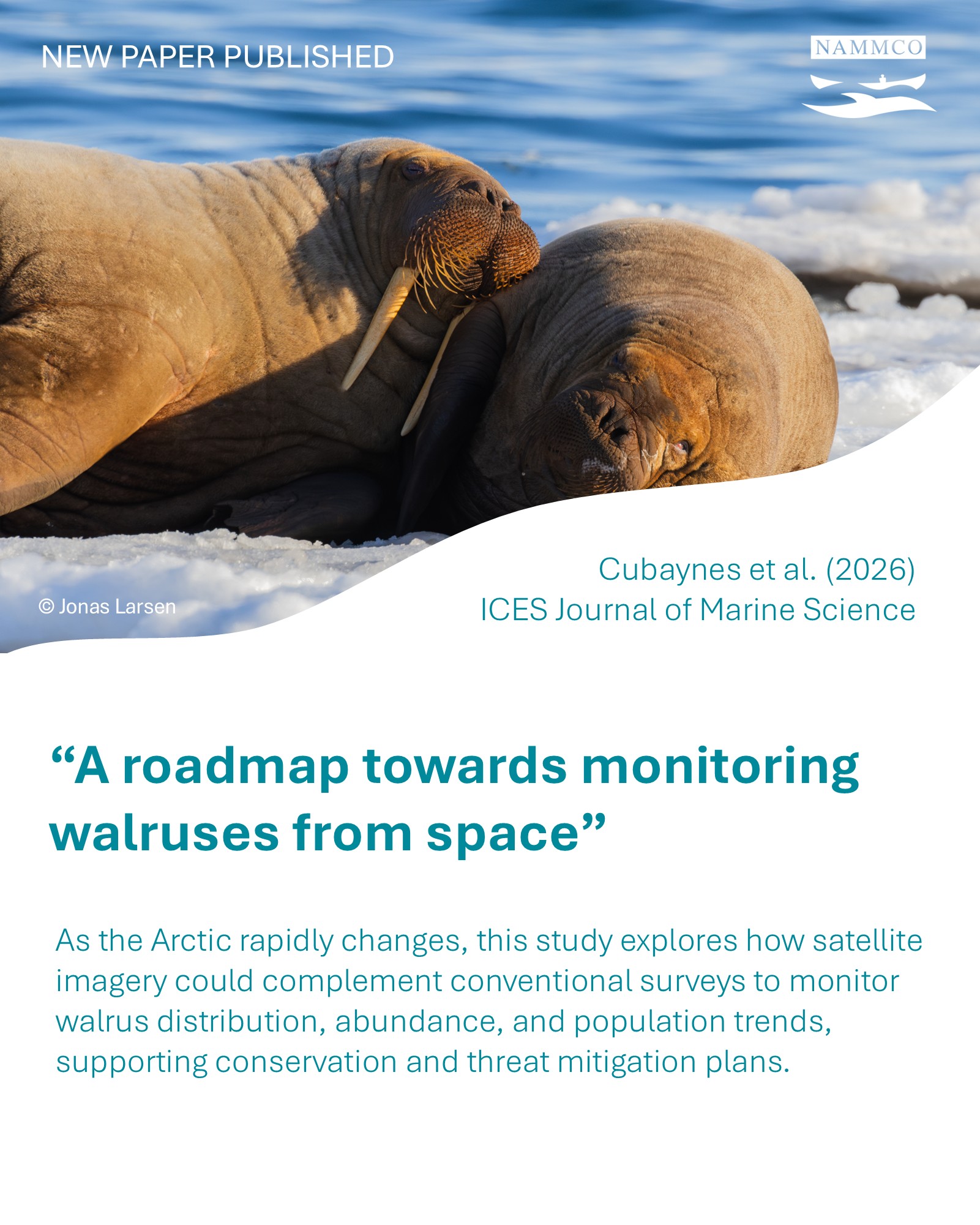
3 November 2026: A new study explores walrus monitoring from space
A study by Cubaynes and colleagues, titled “A roadmap towards monitoring walruses from space”, was published in ICES Journal of Marine Science in January 2026.
Walrus are increasingly affected by rapid changes in their Arctic environment, including the loss of sea ice and growing human activity. Accurate estimates of population size and trends are crucial to understanding how walrus respond to changing Arctic conditions, informing management plans.
Conventional surveys using boats, aircraft, and drones are costly and difficult to carry out across the vast Arctic. This study explores how satellite imagery can be used across large and remote areas to detect and count walrus from space; the authors provide recommendations to monitor numbers and distribution, highlighting its potential as a complementary tool alongside more established methods.
The study weighs the pros and cons of three types of satellite imagery that can be used for walrus monitoring:
🛰️ optical imagery provides high-resolution, easy-to-interpret images and could be used to detect and count individuals
🌍 synthetic aperture radar (SAR) can collect data through clouds and in darkness—useful in Arctic conditions!
🔥 thermal infrared (TIR) detects heat emitted from the Earth’s surface and could potentially detect walrus groups through their heat signature.
The authors also mention that satellite monitoring must be carefully planned, considering image availability, cost, timing, and survey frequency, as any gaps could mean missing periods when walrus numbers are highest.
This new approach is already being tested through initiatives such as the “Walrus from Space” project, which uses satellite imagery and citizen science to detect walrus across the Arctic! Fancy helping to count walrus? The final round starts runs throughout November, find out how to get involved here: https://www.wwf.org.uk/what-we-do/projects/walrus-from-space#get-involved
Read the full paper by Cubaynes et al (2026) here: https://doi.org/10.1093/icesjms/fsag017
Photo credit: Jonas Larsen